Request Job Estimate
 Tap to Call

Introduction
Home renovation projects are rarely limited to new flooring, fresh paintwork, or updated kitchen units. Behind every wall, beneath every floor, and above every ceiling sits a network of plumbing, drainage, heating, and utility systems that can be profoundly disrupted when structural or cosmetic changes are made. Understanding how home renovation affects plumbing and infrastructure is one of the most important — and frequently overlooked — aspects of renovation planning. Without a proper assessment of existing pipework, water supply systems, drainage infrastructure, and heating configurations before work begins, even well-intentioned improvement projects can create costly, disruptive, and sometimes serious long-term problems. This guide explores the key infrastructure considerations every London homeowner should understand before committing to renovation work.
Why Infrastructure Assessment Matters Before Renovation
Many homeowners approach renovation with an understandable focus on design outcomes — the finished kitchen, the extended living space, the converted loft. What is less commonly considered is how those changes interact with the building's existing services infrastructure. A decision to remove a wall, for example, may seem purely structural. In practice, that wall might contain water supply lines, soil pipes, electrical conduits, or heating pipework routed across the property.
Carrying out residential plumbing system assessments before any structural work begins is not a precaution reserved for older properties. Even relatively modern homes can contain undersized supply lines, corroding pipework, or drainage configurations that were never designed to accommodate additional bathrooms, extended kitchens, or new utility rooms.
In London specifically, the diversity of property ages — from Georgian terraces through Victorian and Edwardian housing stock to post-war conversions and modern flats — means that infrastructure conditions vary enormously from one street to the next. A pre-renovation services assessment is the only reliable way to understand what a project is genuinely working with.
How Renovations Affect Plumbing Systems
Water Supply and Pressure Considerations
Changes to a property's layout almost always affect how water is distributed around the building. Adding a new bathroom, extending a kitchen, or converting a basement introduces new demand on the existing water supply system. In older London properties, the main supply line entering the property may be a narrow lead or iron pipe that was originally sized for a much simpler household configuration. Upgrading the main water supply line during renovation is frequently necessary, though it is rarely included in initial project budgets.
Water pressure is particularly vulnerable during renovation. Extending pipework runs, adding bends, or increasing the number of outlets fed from a single supply branch can reduce pressure noticeably at individual fixtures. This is especially relevant in multi-storey properties where upper-floor outlets may already be operating close to minimum usable pressure.
Moving Plumbing Lines During Structural Renovation
Relocating plumbing is one of the more complex and consequential decisions within any renovation project. Moving plumbing lines during structural renovation is not simply a matter of running new pipes to a preferred location. Drainage in particular operates on gravity, meaning that soil and waste pipes must follow defined gradients to function correctly. Moving a toilet or sink away from its existing waste stack requires careful planning to ensure sufficient fall in the drainage run, avoiding partial blockages, slow drainage, and the risk of unpleasant backflow over time.
Supply pipework is generally more flexible to reroute, but wall chases, floor voids, and ceiling routes must all be assessed for structural implications before pipework is altered. In properties with solid concrete floors — common in basement conversions and ground-floor extensions — rerouting drainage can involve significant groundwork that was not anticipated at the planning stage.
Renovation Change vs Potential Infrastructure Impact
| Renovation Change | Potential Infrastructure Impact |
|---|---|
| Removing an internal wall | May sever concealed supply pipes, drainage runs, or heating circuits |
| Adding a new bathroom | Increases demand on supply lines, waste stack, and hot water system |
| Kitchen extension | May require upgraded supply pipework, drainage rerouting, and boiler capacity review |
| Loft conversion | Often requires relocation of cold water tank, vent pipes, and heating feed circuits |
| Basement conversion | Drainage must be pumped or gravity-fed to street level; damp-proofing affects pipe routes |
| Open-plan conversion | Loss of structural walls may expose previously concealed utility routes |
| Underfloor heating installation | Adds load to boiler system; may require pump and controls upgrade |
Drainage Infrastructure: The Most Frequently Underestimated Factor
Drainage is the area of household infrastructure most commonly underestimated during renovation planning. Unlike water supply, which can be pressurised to compensate for design limitations, drainage is entirely dependent on correct configuration, adequate gradients, and unobstructed pipe runs.
Older London properties frequently contain clay drainage systems beneath gardens and footpaths that may be cracked, root-infiltrated, or partially collapsed — conditions that have little visible impact under normal use but become critical failures when renovation work increases the volume or frequency of discharge into the system. A pre-renovation CCTV drainage survey is one of the most cost-effective assessments available, identifying existing defects before they are compounded by new connections or additional loading.
Building extensions over or adjacent to existing drainage runs is another common source of problems. Underground drainage should be identified and mapped before foundation work begins. Damaging a shared or main drain during excavation can have implications extending beyond the property boundary, with associated liability and remediation costs that dwarf the survey cost that might have prevented the issue.
Heating Systems and Hot Water Infrastructure
Boiler and System Capacity
Renovations that increase the heated area of a property — extensions, conservatories, loft conversions, basement rooms — directly increase the demand placed on the existing heating system. A boiler that was correctly sized for a three-bedroom semi-detached home may be insufficient once a double-storey rear extension and a new en-suite have been added. This is a particularly common oversight in London family homes where phased extensions are added over several years without any formal reassessment of system capacity.
Hot water demand follows the same principle. Adding bathrooms, particularly those with shower enclosures, wet rooms, or freestanding baths, significantly increases the volume of hot water required. Where a property relies on a stored hot water cylinder, the cylinder size and recovery rate must be reviewed. Combination boiler systems have finite output capacity and may struggle to maintain pressure and temperature when multiple outlets are used simultaneously in a larger post-renovation property.
Underfloor Heating and Radiator Circuits
Underfloor heating is an increasingly common specification within kitchen extensions and ground-floor renovations. While it is an efficient and comfortable solution, introducing underfloor heating circuits to an existing central heating system adds hydraulic load that must be accommodated through the pump, controls, and boiler output. A professional boiler and system assessment before specifying underfloor heating prevents the disappointment of an underperforming system on completion.
Hidden Defects Uncovered During Renovation
Opening up walls, lifting floors, and removing original fixtures during renovation regularly exposes hidden plumbing issues that were present long before work began. This is one of the most consistent findings across renovation projects in older London properties. Slow weeping joints behind plasterwork, corroded copper pipework in floor voids, displaced waste connections beneath kitchen units — none of these conditions necessarily cause acute failure under normal conditions, but renovation disturbance can precipitate exactly that.
The discovery of concealed defects mid-project is a significant driver of cost overruns and programme delays. Identifying and addressing these conditions proactively — through a pre-renovation plumbing inspection — gives homeowners the opportunity to budget for remediation work before it becomes an emergency. Properties where galvanised steel or original lead supply pipework remains in service face particular risk, as both materials have finite serviceable lifespans and can fail unpredictably when disturbed.
Infrastructure Element vs Recommended Assessment Before Renovation
| Infrastructure Element | Recommended Pre-Renovation Assessment |
|---|---|
| Water supply pipework | Check pipe material, diameter, condition, and stop valve operation |
| Drainage system | CCTV survey to identify cracks, root ingress, or partial blockages |
| Boiler and heating system | Capacity review relative to post-renovation heated area and hot water demand |
| Electrical consumer unit | Assess spare capacity for new circuits, upgraded lighting, and appliances |
| Soil and vent stack | Confirm location, condition, and compatibility with proposed drainage changes |
| Main supply line (MDPE or lead) | Confirm material and whether upgrade is required before extension work begins |
| Cold water storage (where applicable) | Assess capacity and structural support if loft is being converted |
Room-Specific Infrastructure Considerations
Kitchens
Kitchen renovations are among the most infrastructure-intensive home improvement projects. Relocating a sink, dishwasher, or washing machine connection requires moving both supply and waste pipework. Where an island unit is planned, routing supply and waste to a central floor position demands early planning to avoid costly remediation once floor finishes are complete. Any planned kitchen refurbishment should include a review of existing supply pipe sizes and the condition of the waste connection to the main drainage run before the layout is finalised.
Extraction systems in kitchen extensions also interact with HVAC infrastructure and may require structural openings through external walls, with associated building regulations implications.
Bathrooms
Bathroom renovation projects demand particularly careful infrastructure planning when the proposed location falls away from existing waste stacks or on upper floors where drainage runs must pass through intermediate floor structures. Wet rooms and walk-in showers require tanked waterproofing beneath the drainage point, which must be integrated with the subfloor construction. The weight of freestanding baths and large tile formats on upper floors also raises structural load considerations that intersect with both floor construction and the pipework running beneath.
Electrical and Utility Infrastructure Considerations
Plumbing and electrical systems are more closely linked during renovation than many homeowners realise. Wet zones in bathrooms and kitchens impose specific requirements on circuit protection. New circuits for electric showers, underfloor heating controls, or kitchen appliance banks may require consumer unit upgrades or additional capacity that was not budgeted in the initial project scope.
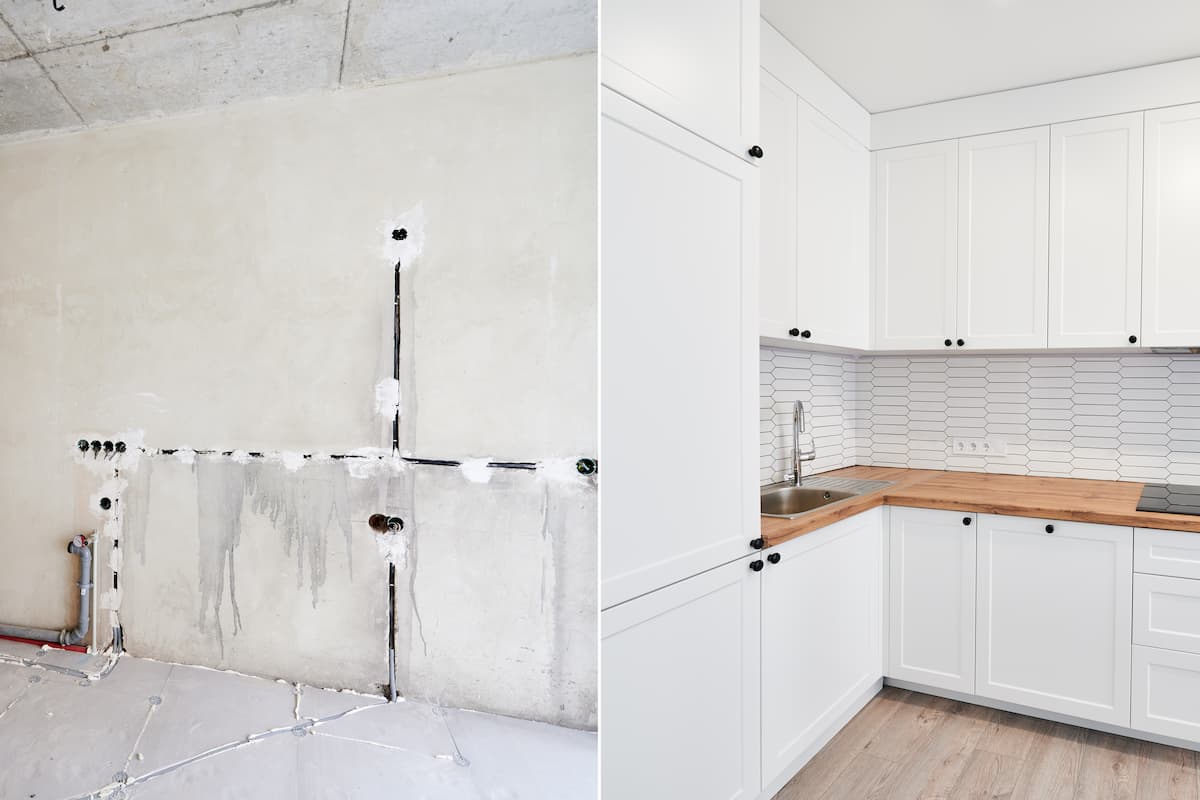
Equally, wall demolition and structural alterations regularly expose electrical conduits alongside plumbing runs. The routing of both services through structural walls means that any significant alteration to the building fabric should involve a utility identification process — ideally using an electronic pipe and cable detector — before cutting, chasing, or demolition commences.
This is not a step that can reasonably be skipped to save time. The consequences of striking a pressurised supply pipe or live conduit during demolition extend from immediate property damage to serious personal risk.
Structural Modifications and Service Routes
Open-plan renovations — among the most popular in London family homes — involve the removal of internal walls that frequently contain or adjoin service routes. Where a wall carries pipework or cable runs that cannot be practically rerouted, the renovation design must either accommodate those constraints or include a properly planned diversion as part of the project scope.
Proper professional plumbing installation is essential wherever supply or drainage pipework is altered, extended, or rerouted as part of structural work. Improvised connections, non-compliant pipe joints, or incorrectly graded drainage runs are among the most common sources of post-renovation plumbing failures — problems that frequently take months or years to manifest but that trace directly back to shortcuts taken during the original building work. Where ageing lead or galvanised steel supply lines are encountered, pipework replacement during the renovation window is significantly more cost-effective than retrofitting after finishes are complete.
Common Infrastructure Mistakes in Home Renovation
A recurring pattern across London renovation projects is the separation of trades. Builders, plumbers, electricians, and heating engineers are often engaged independently and at different stages. Without a coordinating assessment at the outset, each trade works to their own requirements without visibility of the broader infrastructure picture. The result is conflicting service routes, inadequate allowances in structural openings, and infrastructure upgrades that are identified only after work is partially complete.
Another frequent error is assuming that building regulations approval for structural work implicitly covers plumbing and drainage. Building control processes vary, and compliance with structural requirements does not guarantee that drainage connections, water supply modifications, or heating alterations meet current standards. Separate notification and inspection of plumbing and drainage work is required under Part H, Part G, and Part L of the Building Regulations in England, and overlooking these requirements can create complications on future property sales.
Long-Term Maintenance Considerations
A well-planned renovation that accounts for infrastructure from the outset creates a property that performs reliably and remains maintainable for years after completion. Access panels for concealed valves, correctly installed isolation points on new circuits, documented drainage routes, and boiler systems appropriately sized for post-renovation demand all contribute to a property that is easier and less expensive to maintain.
Properties that have been renovated without infrastructure planning tend to accumulate latent problems that surface gradually — reduced water pressure, slow drainage, boiler short-cycling, damp patches around concealed pipe runs. The cumulative remediation cost of these issues frequently exceeds what an adequate pre-renovation assessment would have cost, with the added disruption of having to open up recently completed finishes.
Frequently Asked Questions
How does home renovation affect plumbing?
Renovation work can increase demand on supply and drainage systems, disturb or damage concealed pipework, require rerouting of existing services, and expose hidden defects. The scale of impact depends on the extent of structural alterations and whether a proper infrastructure assessment was carried out before work began.
Should plumbing be inspected before renovation?
Yes. A pre-renovation plumbing inspection identifies the condition of existing pipework, drainage, and supply systems before they are disturbed or placed under increased demand. This reduces the risk of discovering costly problems mid-project and helps ensure that the renovation design is compatible with the property's existing infrastructure.
Can renovations damage existing pipes?
Yes. Wall demolition, floor removal, and foundation work can strike, displace, or compromise concealed supply pipes, drainage runs, and heating circuits. Using an electronic pipe and cable detector before any cutting or demolition work is a straightforward precaution that significantly reduces this risk.
When should water supply lines be upgraded?
Water supply line upgrades should be considered when a renovation increases the number of outlets drawing from the supply, when existing pipework is lead or galvanised steel, when water pressure is already marginal, or when a new property connection is being established for an extension or outbuilding.
What infrastructure should be checked before remodeling?
Before significant renovation work, homeowners should assess the condition and capacity of water supply pipework, drainage systems, the boiler and heating circuit, the electrical consumer unit, soil and vent stacks, and any utility services routed through walls or floors that will be affected by structural alterations.
Do I need building regulations approval for plumbing changes during renovation?
Many plumbing and drainage alterations fall within the scope of Building Regulations in England, including new drainage connections, hot water system modifications, and certain supply pipework changes. It is advisable to confirm with your local authority building control or an approved inspector what notifications are required for the specific works planned.
How do renovations affect water pressure?
Extended pipework runs, additional outlets, and increased household demand can all reduce water pressure at individual fixtures. In properties with existing marginal pressure — common in older London homes — this can become a practical problem. A pressure and flow assessment before design is finalised allows the specification to accommodate supply capacity correctly.
What are the drainage risks in a basement conversion?
Basement conversions present particular drainage challenges because waste and soil connections must often travel upward to reach street-level drainage. This typically requires a macerator or sewage pump system. Existing drainage beneath the basement slab must also be identified and protected during groundwork to avoid damaging shared or main drain connections.
How does renovation affect a boiler or heating system?
Increasing the heated floor area, adding bathrooms, or introducing underfloor heating circuits increases demand on the existing boiler and system. Where a boiler is already operating near its output limit, renovation work can tip the system into consistent underperformance. A heating engineer should assess system capacity as part of the renovation planning process.
How long does a pre-renovation infrastructure assessment take?
This varies depending on property size and the scope of planned works. A thorough plumbing and drainage survey for a typical London terraced or semi-detached home can generally be completed within a few hours. CCTV drainage surveys add time but are a worthwhile investment before significant groundwork or extension work begins.
Conclusion
If you are planning a renovation project in London — whether an extension, conversion, kitchen remodel, or full house refurbishment — taking the time to understand your property's existing infrastructure before work begins is one of the most valuable investments you can make in the project's success.
Explore the residential plumbing services available through the Emergency Plumber London team to find out how a pre-renovation plumbing assessment could protect your project, your budget, and your property’s long-term performance. For a deeper look at how plumbing shapes renovation outcomes, this guide on the role of plumbing in home renovation covers the planning considerations that matter most.
Safety Disclaimer
The information in this article is provided for educational and informational purposes only. Renovation projects vary depending on property type, infrastructure condition, structural alterations, utility configurations, and existing plumbing systems. Nothing in this article constitutes professional advice for any specific property or project. Professional assessments should always be obtained before making significant modifications to plumbing, drainage, electrical, heating, or structural systems. Work affecting gas supplies, drainage connections, or structural elements must be carried out by qualified and appropriately registered professionals.